EUDR · Nigeria · Cocoa · EN
EUDR for Nigerian cocoa: farm geolocation and lot data for EU buyers
From 30 December 2026 European grinders and chocolate makers must file a due diligence statement for every cocoa lot. Nigeria is standard risk, so they run full due diligence – and they need geolocation of every farm from you. This kit organises farms, lots and evidence and checks them before you send.
Instant download (ZIP). Excel + LibreOffice compatible. Checkout link coming soon.
- Excel workbook, 9 tabs, 300 plots
- Offline geolocation checker (no upload)
- English
- Buyer questionnaire DOCX + email templates
- Filled fictional example
- Official sources cited with dates
EUDR for Nigeria cocoa exporters: what changes on 30 December 2026
The EU Deforestation Regulation (EUDR, Regulation (EU) 2023/1115) applies from 30 December 2026 to large and medium EU operators and traders, and from 30 June 2027 to micro and small enterprises (Regulation (EU) 2025/2650). From those dates, an EU company may only place cocoa (HS 1801 beans, 1802 shells, 1803 paste, 1804 butter, 1805 powder and 1806 chocolate) on the EU market if it is deforestation-free (no deforestation after 31 December 2020), produced legally under the laws of Nigeria, and covered by a due diligence statement (DDS).
As a supplier in Nigeria you normally do not submit the DDS yourself – your EU buyer does. But the buyer can only do that with your data: geolocation of every plot, harvest dates, quantities, land and legality documents. That is why EU importers are now sending cocoa suppliers questionnaires, Excel templates and GeoJSON requests. This kit gives you one organised place to prepare those answers.
Nigeria is not listed in Implementing Regulation (EU) 2025/1093, so it has the default standard risk level. EU operators must run full due diligence (information, risk assessment, risk mitigation) – expect detailed questions and document requests.
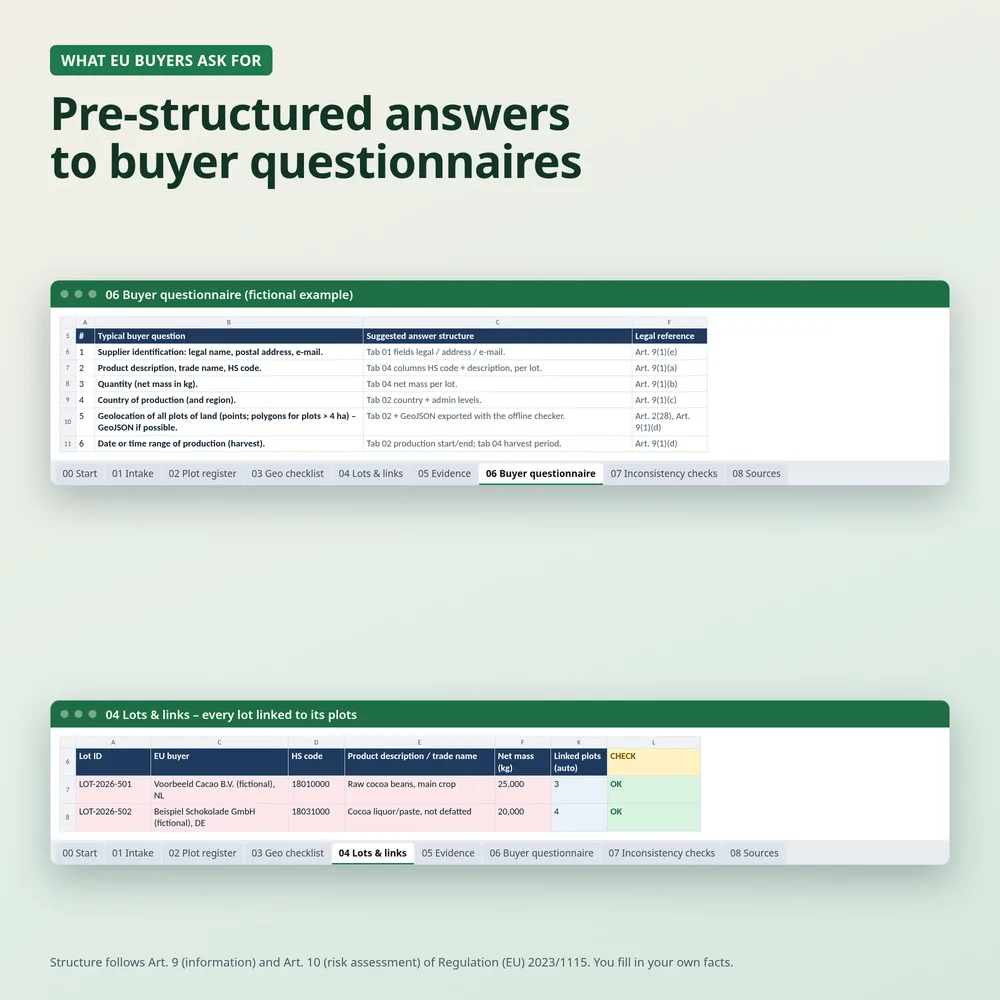
What EU buyers ask their suppliers for
| Buyer request | Legal basis | Where in the kit |
|---|---|---|
| Geolocation of every plot of land (points with ≥ 6 decimals; polygons for plots > 4 ha) | Art. 2(28), Art. 9(1)(d) | Tab 02 Plot register + offline checker + GeoJSON sample |
| Date or time range of production / harvest | Art. 9(1)(d) | Tab 02 (production start/end) |
| Product description, HS code, quantity (net mass) | Art. 9(1)(a)(b) | Tab 04 Lots & links |
| Proof the land was not deforested after 31 Dec 2020 | Art. 2(13), Art. 9(1)(g) | Tab 05 Evidence register |
| Proof of legal production (land-use rights, labour, tax, environment, third-party rights…) | Art. 2(40), Art. 9(1)(h) | Tab 05 + tab 06 questionnaire |
| Supplier identification and supply-chain information | Art. 9(1)(e)(f) | Tab 01 Intake |
| Answers to a risk questionnaire (mixing, traceability, sub-suppliers) | Art. 10 | Tab 06 Buyer questionnaire + DOCX |
Records must be kept for 5 years (Art. 9(1)). The kit does not replace your buyer's own template – it helps you fill any template quickly and consistently.
EUDR geolocation for cocoa farms in Nigeria: the rules that trip suppliers up
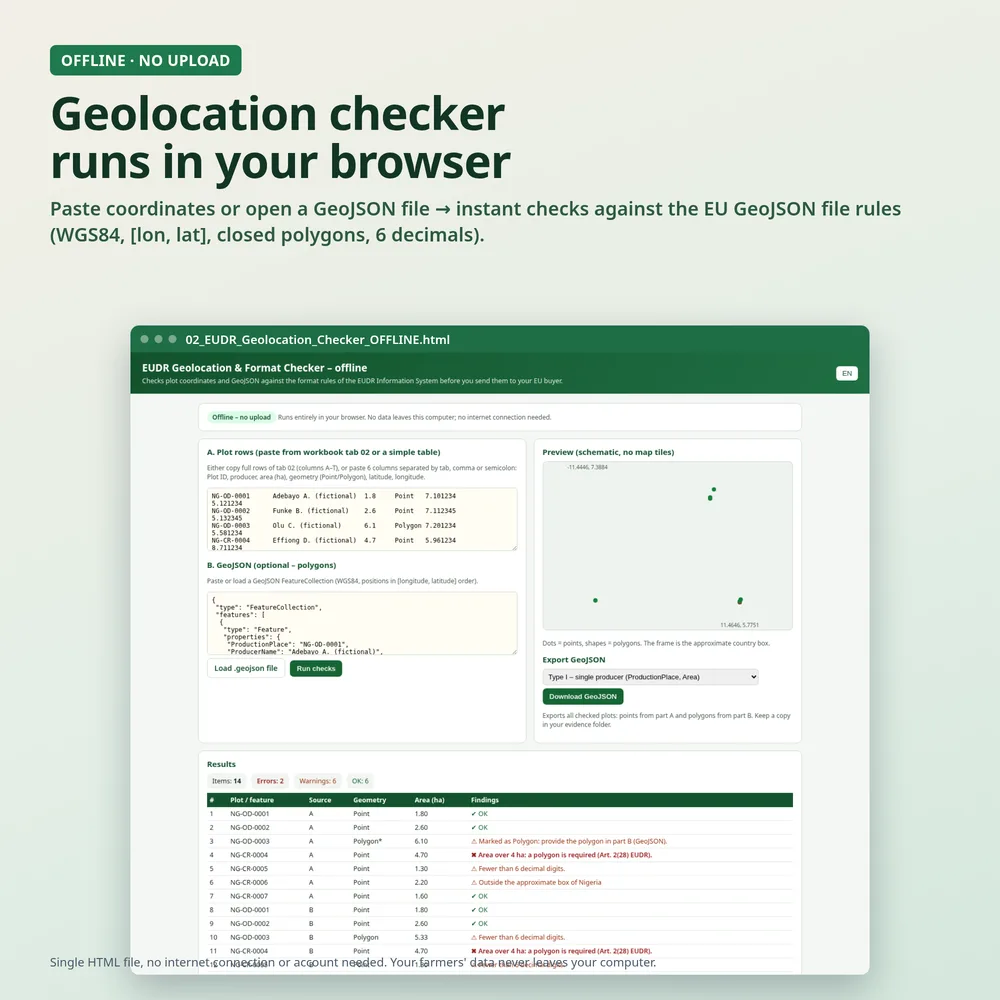
Format (EU GeoJSON file description)
- WGS84 / EPSG:4326 coordinates, order [longitude, latitude]
- At least 6 decimal places
- Point, MultiPoint, Polygon, MultiPolygon only
- Polygons closed, ≥ 4 positions, no holes or self-intersections
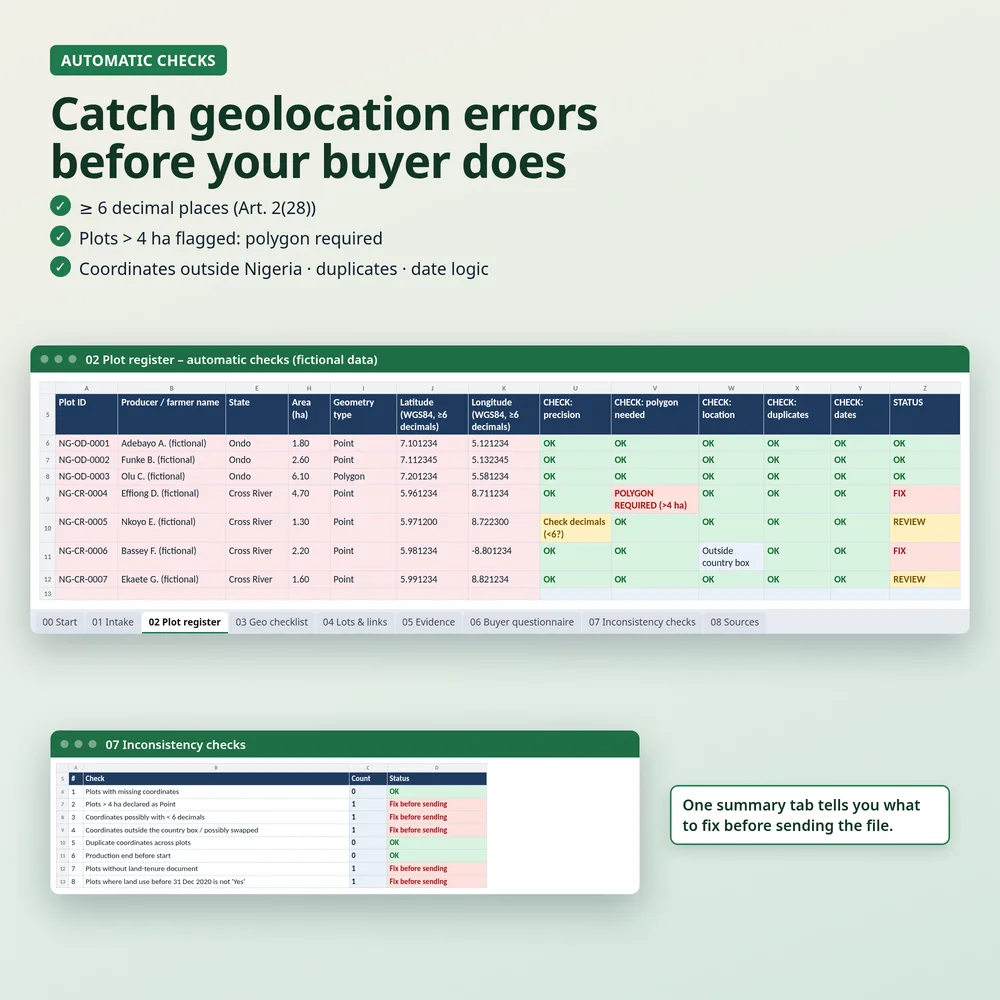
Typical errors the workbook flags
- Coordinates rounded to 4–5 decimals
- Plot > 4 ha given as a single point
- Latitude/longitude swapped or outside Nigeria
- Duplicate coordinates across farmers; harvest end before start
Nigerian cocoa comes mostly from smallholder farms in Ondo, Osun, Cross River, Ogun, Ekiti and Oyo states. Most plots are below 4 ha (a point is enough), but larger farms need a polygon – and buyers look closely at farms near forest reserves and national parks, for example in Cross River. The register keeps state, LGA and community as used on local records.
EUDR due diligence statement: what a cocoa supplier must give the EU buyer
The DDS is filed by the EU operator in the EU information system. It references the geolocation and product data you supply. In practice buyers ask for three deliverables per shipment: (1) a plot list or GeoJSON file, (2) a lot-to-plot link showing which plots supplied each container, and (3) evidence of deforestation-free and legal production. Tabs 02, 04 and 05 of the workbook produce exactly these, and tab 07 counts inconsistencies before you send anything.
Typical Nigerian evidence: Certificate of Occupancy where available, customary right of occupancy, family or community land allocations, tenancy agreements, farmer registers with farmer IDs, child-labour monitoring records, purchase receipts and bag tags from cooperatives or buying agents.
Nigerian cocoa in EU trade
Eurostat Comext shows the EU imported about €1.7 billion of cocoa beans from Nigeria in 2025, plus about €0.1 billion of cocoa paste. Nigeria is not listed in Implementing Regulation (EU) 2025/1093, so standard risk applies: EU buyers must assess and mitigate risk themselves, which is why their questionnaires to Nigerian suppliers are detailed.
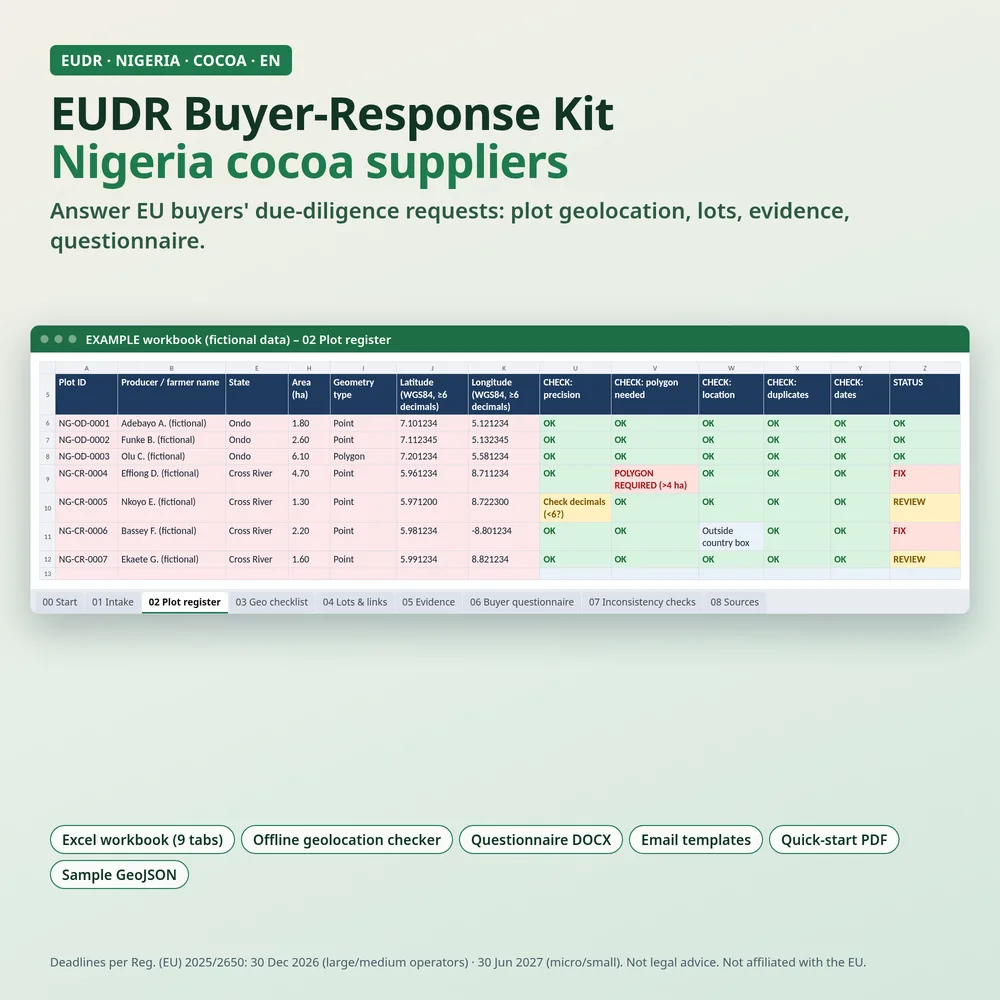
Sample: plot register with automatic checks (Nigeria cocoa, fictional data)
This is a live extract of the filled example workbook included in the kit. The CHECK columns are Excel formulas – they flag missing decimals, plots needing polygons, locations outside the country, duplicates and date errors.
| A | B | E | H | I | J | K | U | V | W | X | Y | Z | |
|---|---|---|---|---|---|---|---|---|---|---|---|---|---|
| 5 | Plot ID | Producer / farmer name | State | Area (ha) | Geometry type | Latitude (WGS84, ≥6 decimals) | Longitude (WGS84, ≥6 decimals) | CHECK: precision | CHECK: polygon needed | CHECK: location | CHECK: duplicates | CHECK: dates | STATUS |
| 6 | NG-OD-0001 | Adebayo A. (fictional) | Ondo | 1.80 | Point | 7.101234 | 5.121234 | OK | OK | OK | OK | OK | OK |
| 7 | NG-OD-0002 | Funke B. (fictional) | Ondo | 2.60 | Point | 7.112345 | 5.132345 | OK | OK | OK | OK | OK | OK |
| 8 | NG-OD-0003 | Olu C. (fictional) | Ondo | 6.10 | Polygon | 7.201234 | 5.581234 | OK | OK | OK | OK | OK | OK |
| 9 | NG-CR-0004 | Effiong D. (fictional) | Cross River | 4.70 | Point | 5.961234 | 8.711234 | OK | POLYGON REQUIRED (>4 ha) | OK | OK | OK | FIX |
| 10 | NG-CR-0005 | Nkoyo E. (fictional) | Cross River | 1.30 | Point | 5.971200 | 8.722300 | Check decimals (<6?) | OK | OK | OK | OK | REVIEW |
| 11 | NG-CR-0006 | Bassey F. (fictional) | Cross River | 2.20 | Point | 5.981234 | -8.801234 | OK | OK | Outside country box | OK | OK | FIX |
| 12 | NG-CR-0007 | Ekaete G. (fictional) | Cross River | 1.60 | Point | 5.991234 | 8.821234 | OK | OK | OK | OK | OK | REVIEW |
| 13 |
All names, coordinates and documents in the example are fictional.
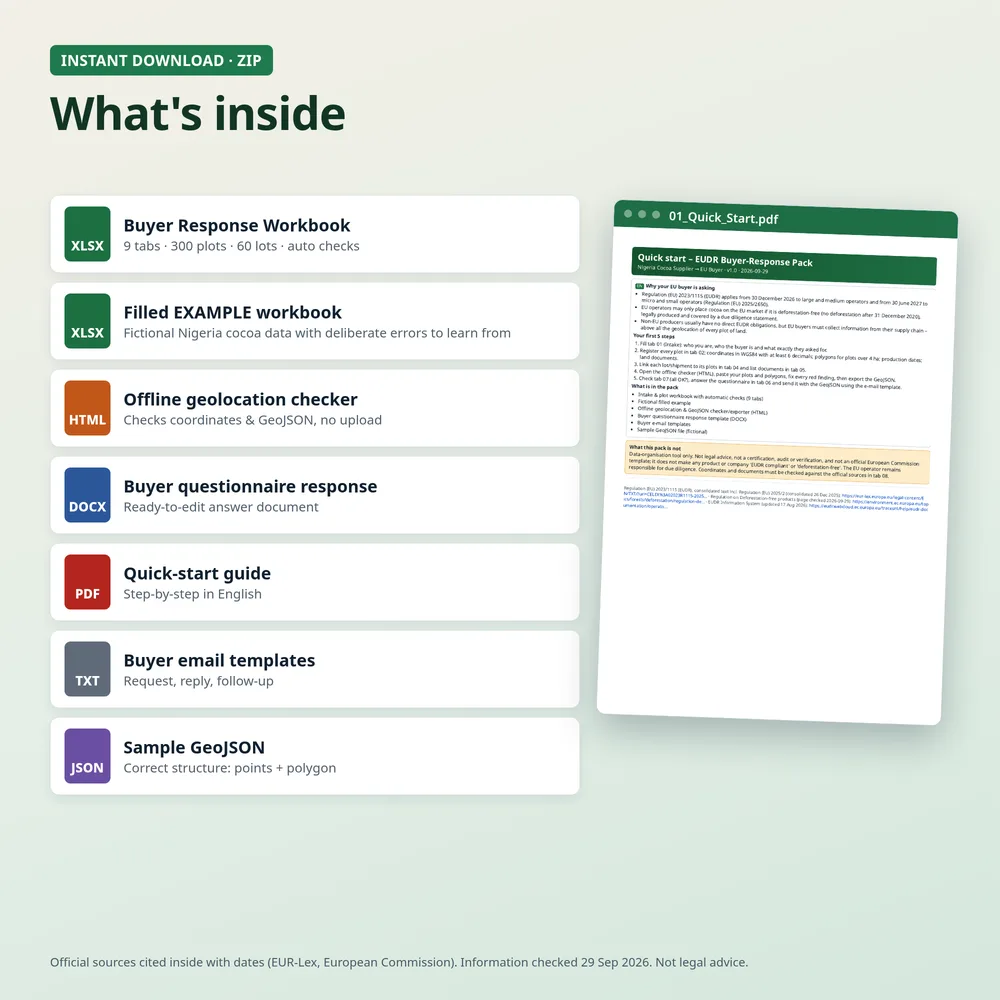
What's inside the ZIP
- EUDR Buyer Response Workbook (.xlsx) – 9 tabs: intake, plot register (300 rows), geolocation checklist, lots & plot links (60 lots / 600 links), evidence register, buyer questionnaire, inconsistency checks, sources & change log; English
- Filled EXAMPLE workbook – fictional Nigeria cocoa data with deliberate errors to learn from
- Offline geolocation checker (.html) – paste coordinates or open a GeoJSON file; checks decimals, polygon closure, self-intersections, country bounding box; exports a clean GeoJSON
- Buyer questionnaire response (.docx) – pre-structured answers mapped to Art. 9 and Art. 10
- Quick-start guide (.pdf) – one-page workflow
- Buyer email templates (.txt) – request, reply and follow-up
- Sample GeoJSON – correct structure with points and a polygon
FAQ
Does the EUDR apply to cocoa exporters in Nigeria?
The legal obligations (due diligence statement) fall on the EU operator placing the cocoa on the EU market. Suppliers in Nigeria are not directly obliged, but EU buyers can only comply with their suppliers' data – plot geolocation, harvest period, quantities and evidence – so in practice every supplier to the EU must provide it.
When does the EUDR apply to cocoa?
From 30 December 2026 for large and medium operators and traders, and from 30 June 2027 for micro and small enterprises, according to Regulation (EU) 2025/2650.
What geolocation format do EU buyers need?
Coordinates in WGS84 with at least 6 decimal places, one point per plot up to 4 ha and a polygon for plots above 4 ha. The EU information system accepts GeoJSON with [longitude, latitude] order; the kit's offline checker validates this.
What is Nigeria's EUDR country risk level?
Nigeria is not listed in Implementing Regulation (EU) 2025/1093, so it has standard risk. EU operators must do full due diligence – information, risk assessment and, where needed, risk mitigation – so buyers typically ask more questions and request more evidence.
Is this an official EU tool or a certification?
No. It is an independent data-organisation kit. It does not certify compliance or file due diligence statements. Official sources are cited so you can verify every rule.
Do cocoa paste, butter and powder need farm data too?
Yes. HS 1801–1806 are in Annex I. Processors must link each batch back to the farms of the beans used; tab 04 of the workbook records these links.
Official sources
Checked on 29 September 2026. Links open the official EU pages.
- Regulation (EU) 2023/1115 (EUDR), consolidated text incl. Regulation (EU) 2025/2650 – EUR-Lex, consolidated 26 Dec 2025
- Regulation (EU) 2025/2650 amending the EUDR (application dates) – Official Journal of the EU, 23 Dec 2025
- Regulation on deforestation-free products – application dates – European Commission, DG ENV, checked 29 Sep 2026
- Delay until December 2026 and other developments in the implementation of the EUDR – European Commission, Access2Markets, 28 Jan 2026
- EUDR Information System – GeoJSON File Description – European Commission (TRACES), updated 17 Aug 2026
- Implementing Regulation (EU) 2025/1093 – country benchmarking – EUR-Lex, 22 May 2025
- EUDR implementation – how the EUDR applies outside the EU – European Commission, Green Forum, checked 29 Sep 2026
- FAQ – EUDR implementation – European Commission, see page
- Eurostat Comext – EU imports by partner and product (DS-045409), 2025 – Eurostat, dataset updated 15 Sep 2026
Be ready before your buyer's deadline
Organise plots, lots and evidence once – then answer every EU buyer's EUDR request from the same file.
Get the kit · €79Not legal advice. This kit is a data-organisation tool; it does not certify compliance, does not file due diligence statements and is not an official European Commission product. RegPacks is not affiliated with the EU. Regulations and guidance may change – check the official sources.