CBAM · China · Steel & aluminium · EN/ZH
CBAM for Chinese steel and aluminium exporters: give EU buyers actual embedded-emissions data
Since 1 January 2026 EU importers are in the CBAM definitive period and need your installation's embedded emissions. This bilingual English–Simplified Chinese kit structures installation, process and activity data in one Excel file and calculates SEE with transparent formulas.
Instant download (ZIP). Excel + LibreOffice compatible.
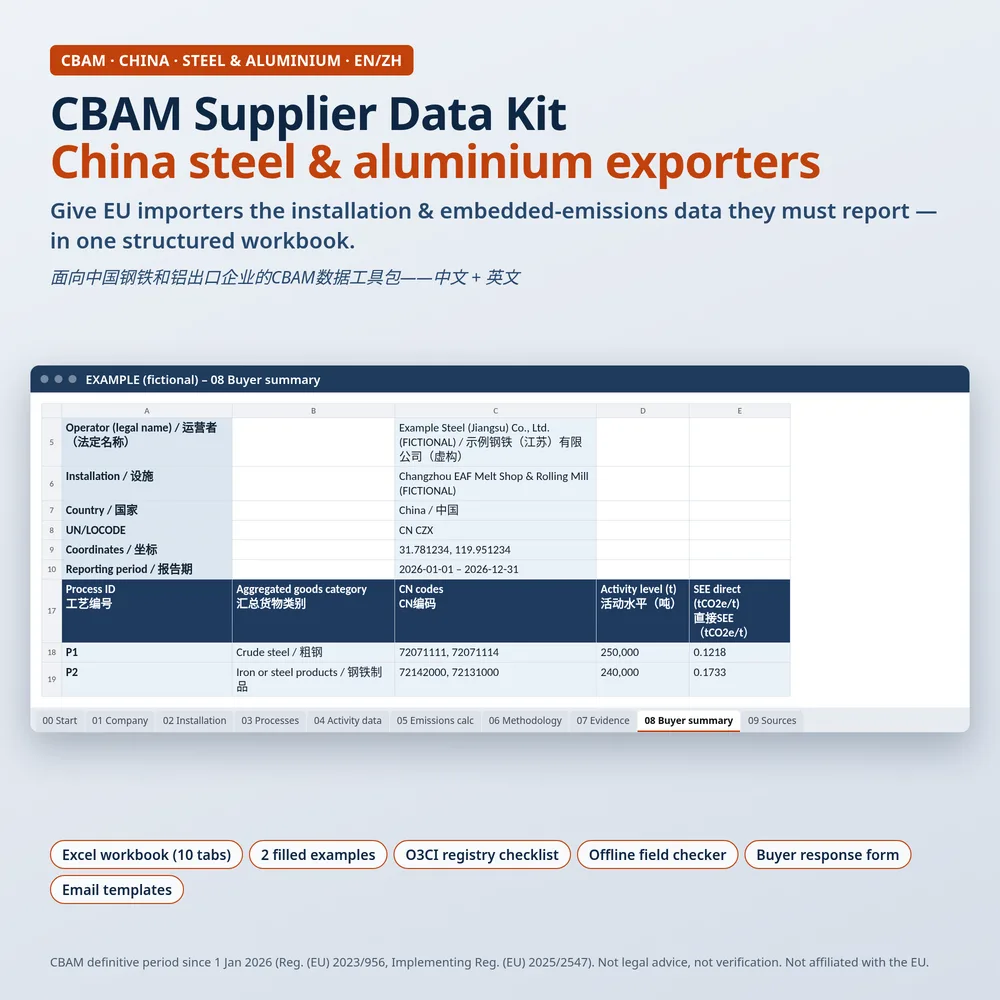
Screenshots
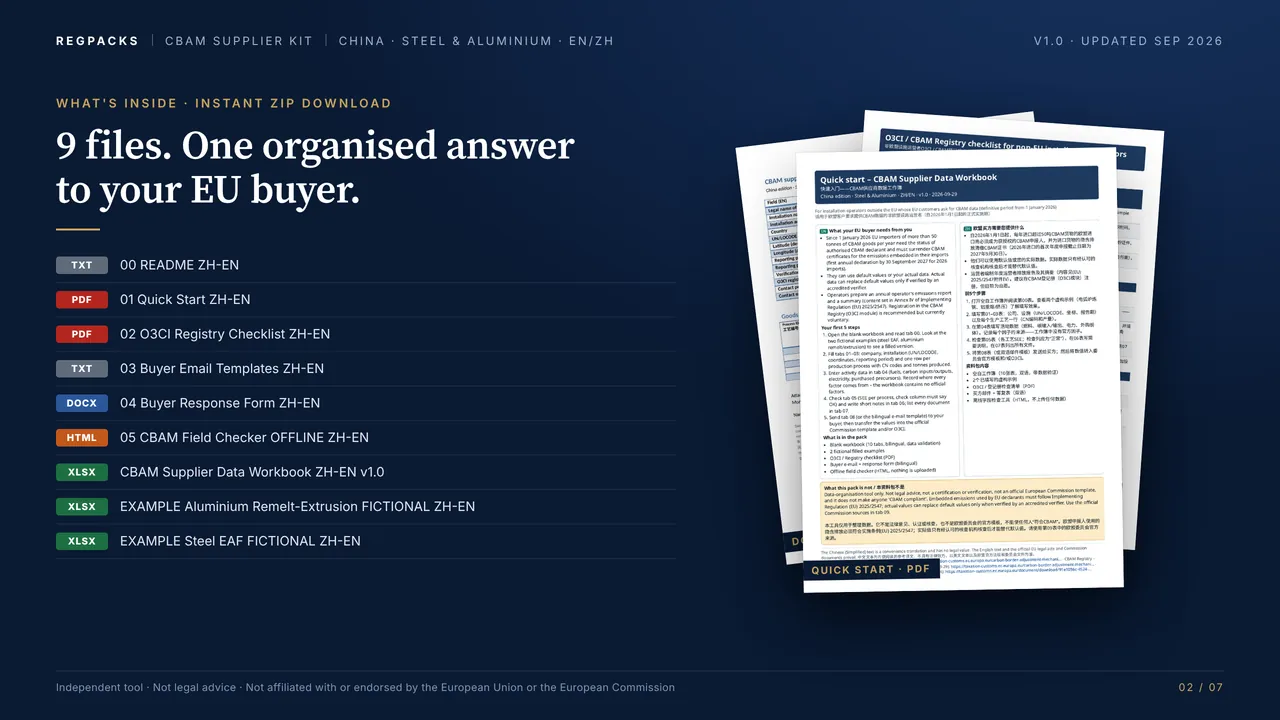
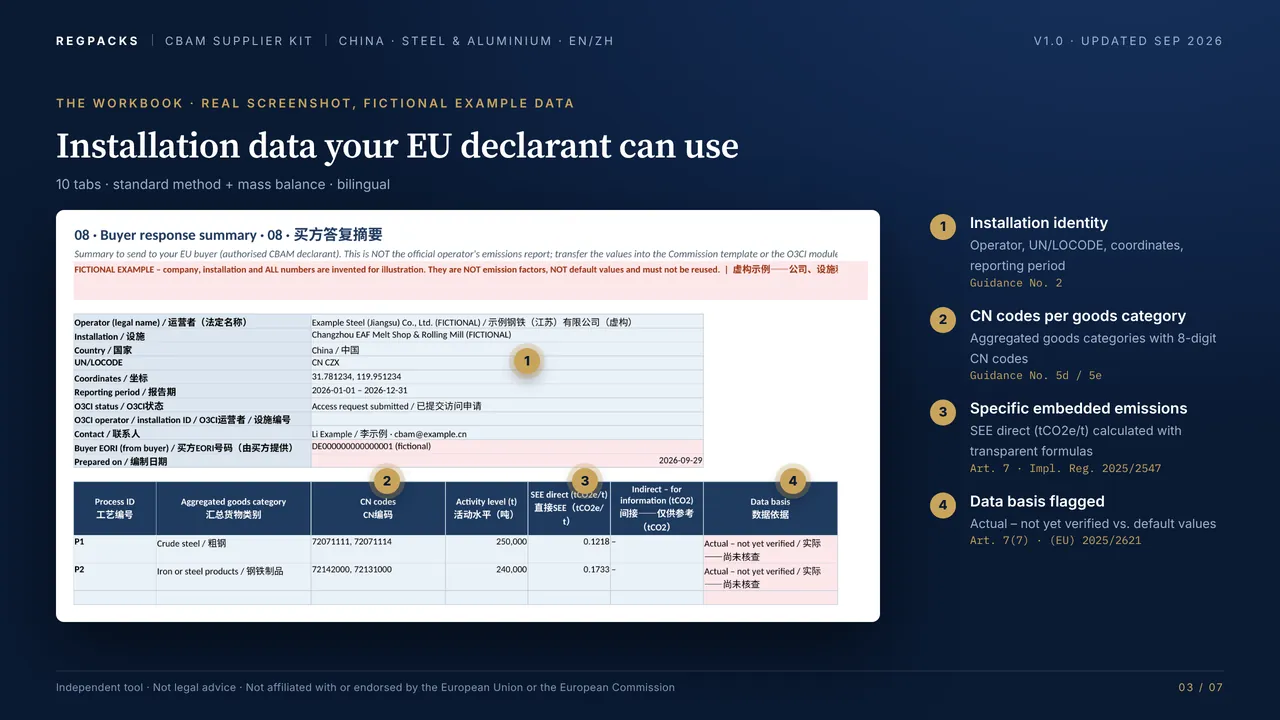
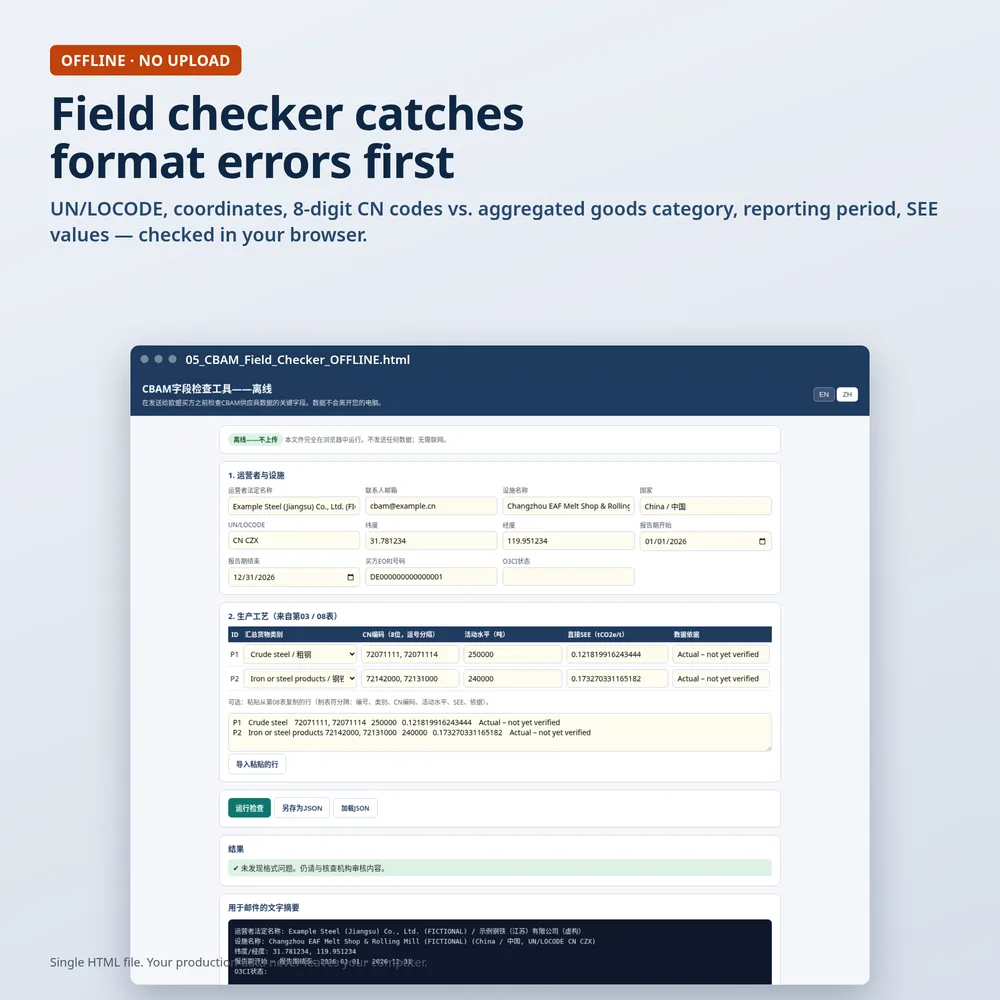
What's inside the ZIP
How it works – 3 steps
Describe
Company, installation (UN/LOCODE, coordinates), processes and CN codes.
Calculate
Enter activity data; the workbook computes attributed emissions and SEE with visible formulas.
Send
Run the offline field checker, send the buyer summary and transfer the values into the Commission template or O3CI.
CBAM for China steel and aluminium exporters: what applies in 2026
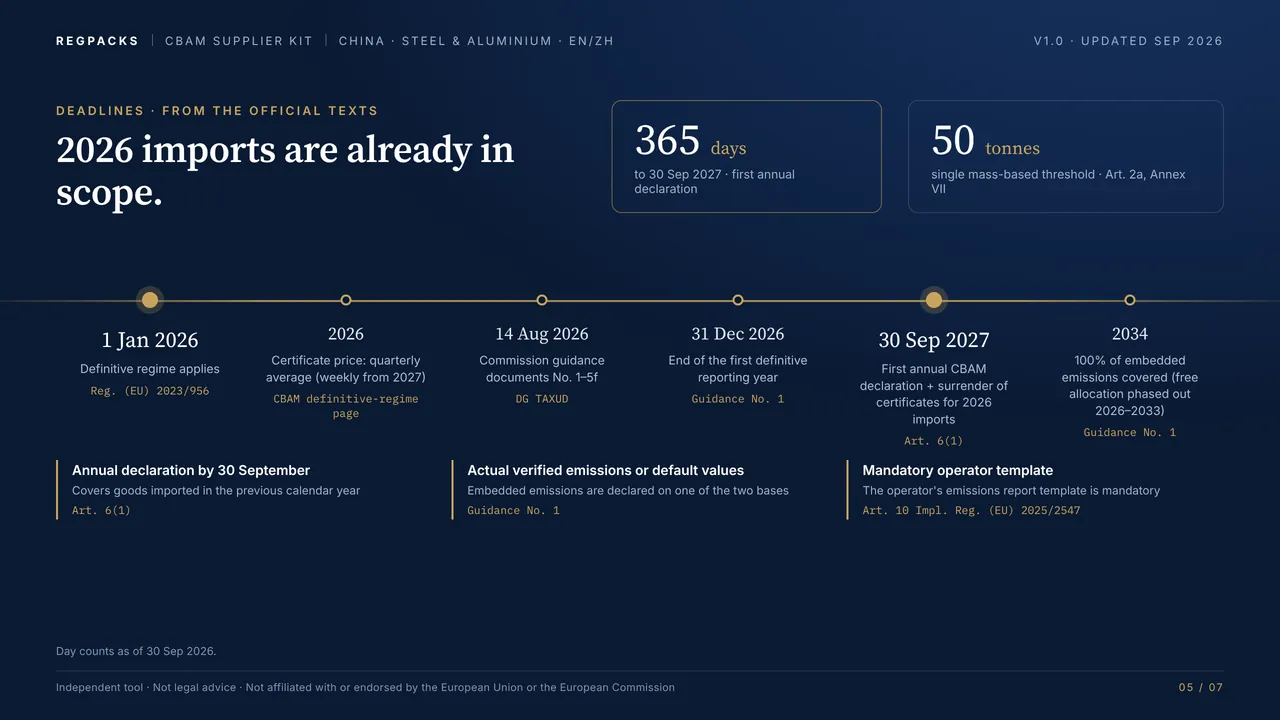
Since 1 January 2026 the EU Carbon Border Adjustment Mechanism (CBAM, Regulation (EU) 2023/956) is in its definitive period. EU importers of more than 50 tonnes a year of CBAM goods must be authorised CBAM declarants, and from 2027 they file an annual declaration (by 30 September) and surrender CBAM certificates for the embedded emissions of the goods they imported in the previous year.
The importer can use default values – which are set conservatively and are often less favourable than well-documented actual data – or the actual emissions of your installation. Actual data must come from you, the producer in China. That is why EU customers now send China mills and extruders questionnaires about installations, production processes, CN codes and specific embedded emissions (SEE).
Eurostat Comext: in 2025 the EU imported about €13.6 bn of iron and steel (chapter 72 + CBAM headings of chapter 73) and €4.0 bn of aluminium (chapter 76 excl. scrap) from China – the largest CBAM origin.
What EU importers ask their non-EU suppliers for
| Request | Basis | Where in the kit |
|---|---|---|
| Operator and installation identification, UN/LOCODE, coordinates | Reg. 2025/2547, Annex IV | Tabs 01–02 |
| Production processes, aggregated goods categories, production routes, CN codes | Guidance 5d / 5e | Tab 03 |
| Activity data per source stream (fuels, electrodes, carbonates, mass balance) | Guidance No. 3 | Tab 04 |
| Attributed direct emissions and SEE per process (tCO2e/t) | Reg. 2025/2547 | Tab 05 (formulas) |
| Monitoring methodology description (in English) | Guidance No. 2 | Tab 06 |
| Evidence and verification status; carbon price paid | CBAM Reg. Art. 8–9 | Tabs 07–08 |
| O3CI registration of the installation (voluntary, recommended) | CBAM Registry | O3CI checklist PDF |
For iron/steel and aluminium goods listed in Annex II of the CBAM Regulation only direct emissions count; indirect emissions are recorded for information.
O3CI: registering your installation in the CBAM Registry
The Commission's O3CI portal lets non-EU operators register installations and share emissions data with EU declarants. Access requires EU Login with two-factor authentication, an onboarding form (company identifiers, company e-mail/website, role) and one PDF with the registration certificate, proof of representation and the representative's ID. Declarants find your data using their EORI. Registration is currently voluntary but recommended (Guidance No. 2, 14 Aug 2026). The kit's checklist walks you through each step.
How the workbook calculates specific embedded emissions
- Standard method for fuels: activity data × NCV × emission factor × oxidation factor
- Mass balance for carbon inputs/outputs (electrodes, charge carbon, scrap, product, slag): ± quantity × carbon content × 44/12
- Heat imported/exported, PFC emissions (aluminium), and precursors (purchased or produced in an earlier process)
- Result: SEE direct in tCO2e per tonne of product for each process, copied to the buyer summary
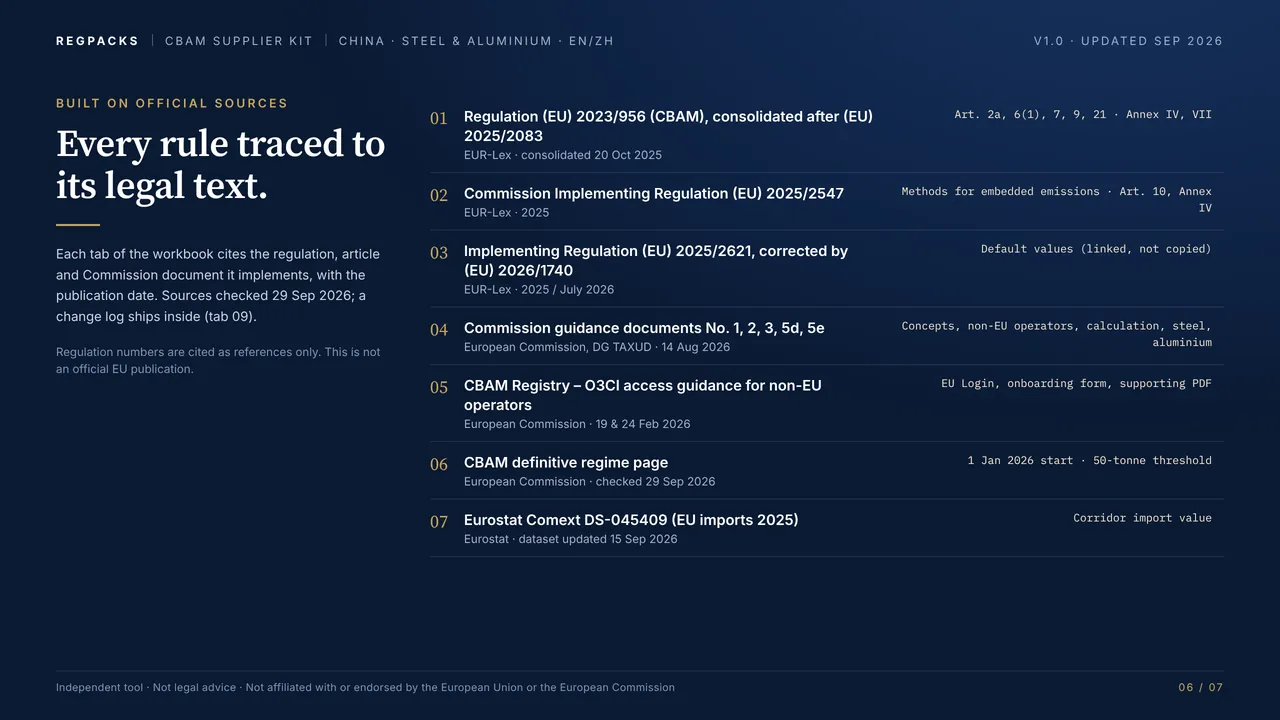
Default values are not copied into the workbook; links point to the official Commission lists (Reg. (EU) 2025/2621 as corrected by (EU) 2026/1740).
Sample: attributed emissions and SEE (fictional steel EAF plant)
Live extract of the filled example workbook: every number is calculated by formulas from the activity-data tab.
| A | B | C | E | G | H | I | J | L | |
|---|---|---|---|---|---|---|---|---|---|
| 41 | Process ID 工艺编号 | Process name 工艺名称 | Source-stream emissions (tCO2) 源流排放(tCO2) | Heat imported (tCO2) 输入热(tCO2) | Attributed direct emissions (tCO2e) 归属直接排放(tCO2e) | Purchased + internal precursors: embedded direct emissions (tCO2e) 外购 + 内部前体的隐含直接排放(tCO2e) | Activity level (t) 活动水平(吨) | SEE direct (tCO2e/t) 直接SEE(tCO2e/t) | Check 检查 |
| 42 | P1 | EAF melt shop – billets | 30,454.98 | 0.00 | 30,454.98 | 0.00 | 250,000.00 | 0.1218 | OK / 正常 |
| 43 | P2 | Rolling mill – rebar & wire rod | 11,739.00 | 0.00 | 11,739.00 | 29,845.88 | 240,000.00 | 0.1733 | OK / 正常 |
All companies and values in the examples are fictional and must not be used as reference data.
FAQ
Do Chinese exporters have CBAM obligations?
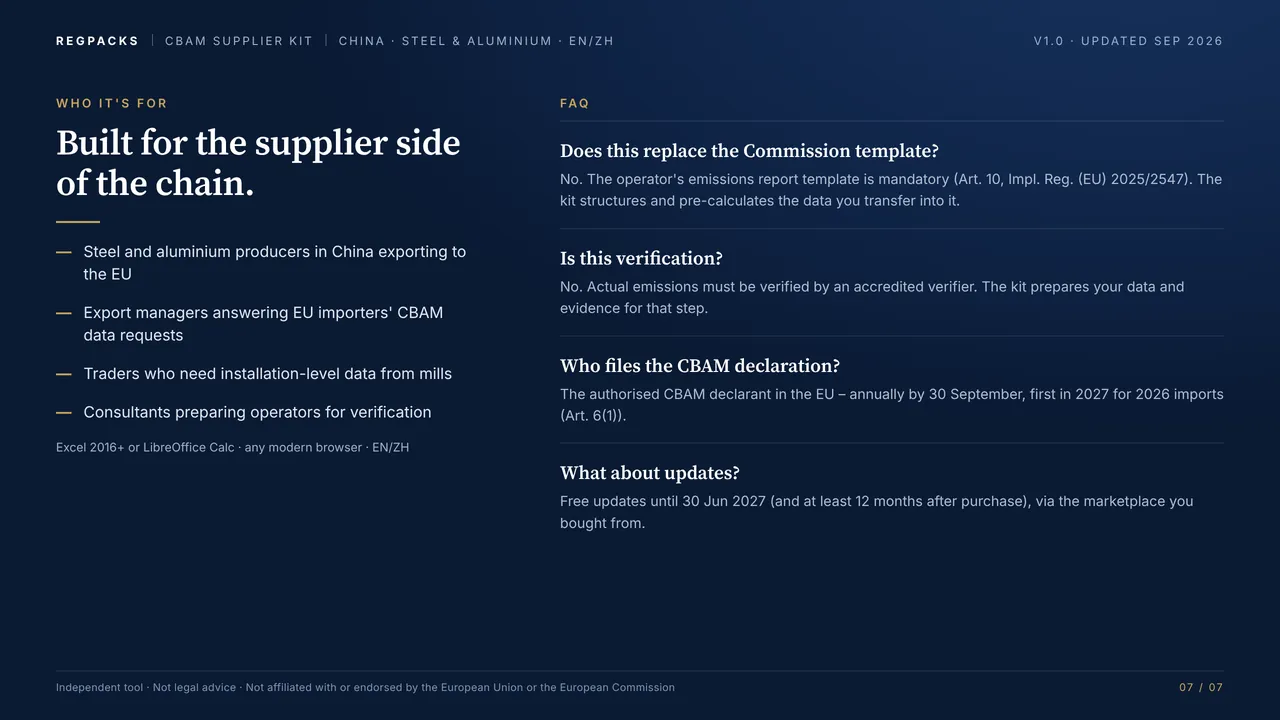
The CBAM obligations (authorisation, declaration, certificates) are on the EU importer or its representative. Chinese producers are not directly obliged, but only they can provide actual embedded-emissions data; without it the importer has to use default values.
What is the CBAM reporting period for installations?
In the definitive period the reporting period is the calendar year; the first annual CBAM declaration covering 2026 imports is due by 30 September 2027 (Commission Guidance No. 1).
Is this the official Commission communication template?
No. The Commission publishes an Excel communication template (not compulsory but recommended). This kit organises your data, calculates SEE and helps you fill the official template or any buyer template consistently.
Do I need to register in O3CI?
Registration of installations in the CBAM Registry (O3CI) is currently voluntary but recommended, according to Guidance No. 2 of 14 August 2026. The kit includes a checklist of the access steps.
Does the kit include default values?
No. Default values are legally set by Implementing Regulation (EU) 2025/2621 (corrected by (EU) 2026/1740); the workbook links to the official sources instead of copying them.
Is a carbon price paid in China taken into account?
The CBAM Regulation (Art. 9) allows a reduction for a carbon price effectively paid in the country of origin, if documented and certified. The workbook records whether a carbon price was paid and the evidence; it does not calculate the reduction.
Are updates included?
Yes: free updates until 30 Jun 2027 and in any case for at least 12 months after purchase. If the cited acts, guidance or default-value corrections change, the updated files appear in your Gumroad library and buyers are notified by e-mail.
Official sources
Checked on 29 September 2026.
- CBAM definitive regime (from 1 January 2026) – European Commission, DG TAXUD, checked 29 Sep 2026
- CBAM Registry and reporting – O3CI module for non-EU installation operators – European Commission, DG TAXUD, checked 29 Sep 2026
- Commission publishes ten CBAM guidance documents for the definitive period – European Commission, 14 Aug 2026
- Guidance No. 2 – Quick guide for non-EU operators – European Commission, 14 Aug 2026
- Implementing Regulation (EU) 2025/2547 – methods for calculating embedded emissions – EUR-Lex, 2025
- Implementing Regulation (EU) 2025/2621 – default values (corrected by (EU) 2026/1740) – EUR-Lex, 2025 / Jul 2026
- Regulation (EU) 2023/956 (CBAM Regulation), consolidated – EUR-Lex, 20 Oct 2025
- CBAM communication template for installations + examples – European Commission, template 18 Dec 2024
- Eurostat Comext – EU imports by partner and product (DS-045409), 2025 – Eurostat, dataset updated 15 Sep 2026
Send EU buyers actual data instead of default values
Structure your installation data once and reuse it for every EU customer.
Get the kit · €59Not legal advice and not verification. This kit is a data-organisation tool; it is not the official Commission communication template and not an official European Commission product. RegPacks is not affiliated with the EU. Values must be monitored and verified according to the CBAM rules.